In Stock
Share your international phone number to discuss pricing and delivery:
Buy this product in 1 click:
Or contact us directly via:


Share your international phone number to discuss pricing and delivery:
Or contact us directly via:
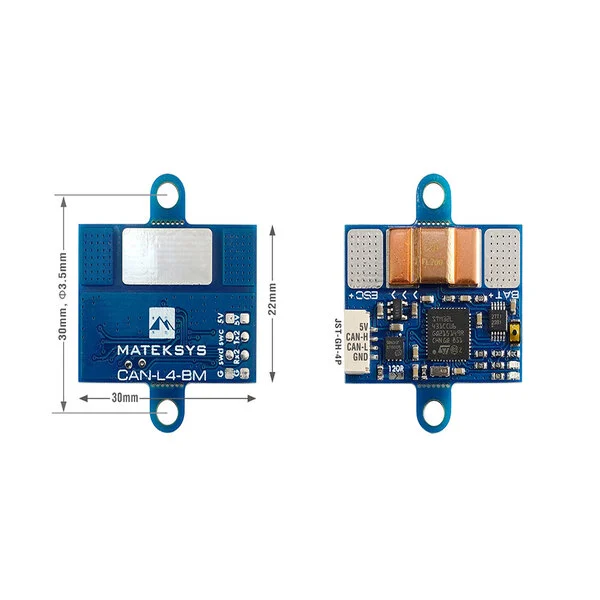
The Matek Systems CAN-L4-BM is a high-precision digital power monitoring module for UAVs and autonomous systems. Built around the INA239 monitoring IC and an STM32L431 microcontroller, it provides accurate current, voltage, and power data via the DroneCAN protocol. Designed for use with modern autopilots, it eliminates analog signal loss and supports robust, low-noise power telemetry across CAN networks.
Table 2-1. CAN-L4-BM Electrical and Functional Specifications
| Manufacturer | Matek Systems |
| Model | CAN-L4-BM |
| Microcontroller | STM32L431xC – 256 KB Flash |
| Power Monitor IC | Texas Instruments INA239 (16-bit ADC, SPI bus) |
| Interface | CAN (DroneCAN), UART2 (DFU), ST-Link Debug |
| Voltage Measurement Range | 0 V ~ 85 V DC |
| Current Measurement Range | 0 A ~ 204.8 A (150 A continuous) |
| Voltage Accuracy | ± 0.1 % |
| Current Accuracy | ± 2 % |
| Shunt Resistance | 200 µΩ (typical) |
| Power Supply Input | 4.5 V – 5.5 V (via 5 V pad/pin) |
| Power Consumption | ~ 10 mA typical |
| Operating Temperature | –40 °C ~ +85 °C |
| Dimensions | 30 mm × 22 mm × 3 mm |
| Weight | ≈ 4 g |
| Firmware | AP_Periph DroneCAN Node (Matek L4 series) |
Table 3-1. Operating Conditions
| Parameter | Min | Typ | Max | Unit |
|---|---|---|---|---|
| Supply Voltage (VCC) | 4.5 | 5.0 | 5.5 | V |
| Operating Current | – | 10 | 15 | mA |
| Bus Voltage Input Range | 0 | – | 85 | V |
| Continuous Current | – | – | 150 | A |
| Peak Current (Short Duration) | – | – | 204.8 | A |
| Shunt Resistance | – | 0.0002 | – | Ω |
Table 4-1. CAN-L4-BM Physical Data
| Dimensions (L × W × H) | 30 mm × 22 mm × 3 mm |
| Weight | ≈ 4 g |
| Connector | JST-GH 4-Pin (CAN Bus) |
| Mounting Type | Inline between battery and ESC/power distribution |
NOTE: Ensure heavy-gauge wires are soldered securely and thermal dissipation is sufficient during high-current operation.
CAN_P1_DRIVER = 1) in ArduPilot or PX4 firmware.Table 6-1. Environmental Ratings
| Operating Temperature | –40 °C ~ +85 °C |
| Storage Temperature | –45 °C ~ +90 °C |
| Humidity | 5 % ~ 95 %, non-condensing |
| Shock Resistance | 25 g / 11 ms half sine wave |
| Vibration Resistance | IEC 60068-2-6 compliant |
There are no reviews for this product.
There are no reviews for this product, be the first to leave your review.
No questions about this product, be the first and ask your question.